
Celebrating International Women’s Day on March 8th, 2026 provides a vital moment to focus on economic empowerment, workplace equality, and the essential support of minority and female entrepreneurs.
I recently applied for certification as a woman-owned business in the Commonwealth of Massachusetts through the Supplier Diversity Office (SDO). Historically known as SOMBA (State Office of Minority Business Assistance) before 1984, and later SOMWBA, the agency has evolved in name but remains steadfast in purpose: to support, certify, and promote minority-owned business enterprises. As I worked on my application for Fortify Advisory, I couldn’t help but think of the trailblazers who cut the path before me as female business owners.
Learning from the Female Trailblazers Before Us
My mom, Lana Adams, gave me my first glimpse of what a female-owned business looked like in the late 1970s. Like many entrepreneurs, she leaned into the “high-tech” of the era, investing in an electric typewriter and later a word processor to launch Pro Type Steno Service in our small town of Wisconsin Rapids, Wisconsin. No website, just a yellow-page ad, she filled a critical need: transforming handwritten manuscripts and contracts into professional, typewritten documents with speed and precision. And she was a business owner while also juggling a dozen other roles.
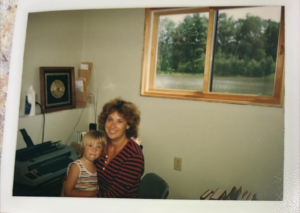
In 1981, we had just moved in to our new house, shelves and file cabinets not yet in place in the above photo. My parents built this house out of town on an 85-acre family farm, passed down from my mom’s side, our Great Aunt Emma Neitzel. Unlike the old farmhouse that my aunt Emma lived in across the yard, the house my parents built was open-concept, energy efficient, and full of big windows that looked out onto a crystal clear pond to the south and other peaceful landscapes in every direction. And they didn’t just hire builders – for months, their brothers, sisters and dear friends, many of whom worked in skilled trades, would descend on the land, and help my parents knock out projects.
Her and my dad’s success was never measured in millions, but in the example they provided. They sustained a comfortable middle-class lifestyle for me and my sisters, and offered proof that while success isn’t guaranteed, a solid work ethic is currency for opening doors.
Almost 50 years later, my mom continues to exemplify the importance of hard work and long term investments. Now retired, she treats her health like it’s her job and enjoys her free time and financial nest egg by frequently traveling and generously including kids and grandkids in her vacations and adventures.
And of course, my mom attributes much of her success to her own mother, a resourceful and hard-working woman, my Aunt Emma, farm owner and operator, and so many other strong women in the family that came before her.
From Small Towns to Global Stages – Women Are Making an Impact and Redefining Success
Beyond my own family and small town of Wisconsin Rapids, I also think about some giants like Judy Faulkner—a fellow University of Wisconsin alumna and CEO of Epic Systems (Epic). Based in Verona, Wisconsin, Epic is now an $8B+ revenue powerhouse. Judy started the company in 1979 with $70,000 and a mission to solve the outdated and slow medical recordkeeping problems that were causing errors in treatment.
In these past 50 years, Judy didn’t just build a solution; she built a legacy of giving. Having signed Warren Buffett’s Giving Pledge, she founded “Roots & Wings” to redistribute 99% of her fortune. As she elegantly put it, “My goal…is to help others with roots—food, warmth, shelter, healthcare, education—so they too can have wings.”
Then there is 38-year-old Melanie Perkins, co-founder and CEO of Canva, valued in 2025 at $42B. Melanie and her husband, Cliff Obrecht, have pledged 80% of their stake to charitable causes. Melanie is quoted as saying, “Success isn’t just about personal wealth. Remember, you’re purely a custodian of your success; use it to make a positive impact.”
Trailblazers like Judy, Melanie, and my mom represent more than just financial success; they represent how success can be also be used for the greater good. By leveraging their own success to lift up the next generation, they exemplify what minority leaders can achieve for their communities.
Trends Show Progress in Growth of Minority Businesses but There is More To Do
According to the U.S. Census Bureau Annual Business Survey (ABS), minority-owned employer firms are growing and now make up over 20% of total businesses. However, the revenue share still lags, with total receipts estimated at less than 8% of total business revenue. Whether this disparity is due to systemic hurdles, the scale of non-minority corporations, or something else, one thing is clear: we have extensive room to grow and expand minority businesses.
While few of us are destined to build billion-dollar companies, many of us will successfully scale a small business that sustains ourselves and our teams. As we grow, the real success comes when we use our influence to help others pursue opportunities, mentoring those following in our footsteps, and using our platform to propagate success for other minorities.
The Value of Minority Certification
You might wonder: What does certifying your business as minority-owned/woman-owned actually do? Here are five key benefits:
- Government Contracts: Gain access to public sector contracts specifically earmarked for minority-owned suppliers.
- Private Sector Opportunities: Many Fortune 500 companies have “Supplier Diversity” goals and actively seek certified partners.
- A Diverse Network: Certification grants access to exclusive conferences, training, and a community of like-minded peers.
- Targeted Growth: Some larger organizations offer accelerator training programs and other mentoring designed specifically to scale certified small businesses.
- Legitimacy: Those who research or go through with the certification process know its rigor, requiring banking, ownership, and operational transparency. The rigorous certification and vetting process legitimatizes your business in the eyes of major partners.
The Intersection with Digital Marketing
Merriam-Webster defines marketing as: The process or technique of promoting, selling, and distributing a product or service. In order promote something, you need to shine a light on what makes it special, unique. Placing your certification logo and seal in your website footer and email signature showcases a reputable, credible operation and signals your commitment to the minority-owned business community. It indicates your readiness to collaborate within that high-value network, too.
International Women’s Day began in 1911 to celebrate women’s accomplishments, break down gender barriers, promote women’s rights activism, and discourage discrimination across the world. As we celebrate International Women’s Day in 2026, we need it just as much as we did over 100 years ago.
If you haven’t yet and you’re eligible, consider commemorating the day by starting the process of certification. Otherwise, consider getting to know your local SDO and network with a Minority or Woman-owned Businesses.