
It is a term that was officially coined in 2003 by Bev Burgess but has been around in practice forever. For small and mid-sized professional services firms, ABM is often the smartest next marketing investment because it works the way these firms already win business.
Most growing firms reach the same crossroads. Referrals and partner relationships built the practice, but they won’t carry it to the next stage. Leadership knows it needs marketing. Yet broad campaigns, impressions and lead volume feel abstract to firms whose best clients came from a handshake, a trusted introduction or a long-term relationship.
ABM resolves that tension. It gives firms a disciplined, measurable way to grow without abandoning what already works.
What ABM is, in plain terms
Account-based marketing flips the traditional funnel. Instead of casting a wide net and sorting through whoever responds, a firm starts by naming the specific organizations it wants to win. Then it builds marketing and outreach around those accounts and the people inside them.
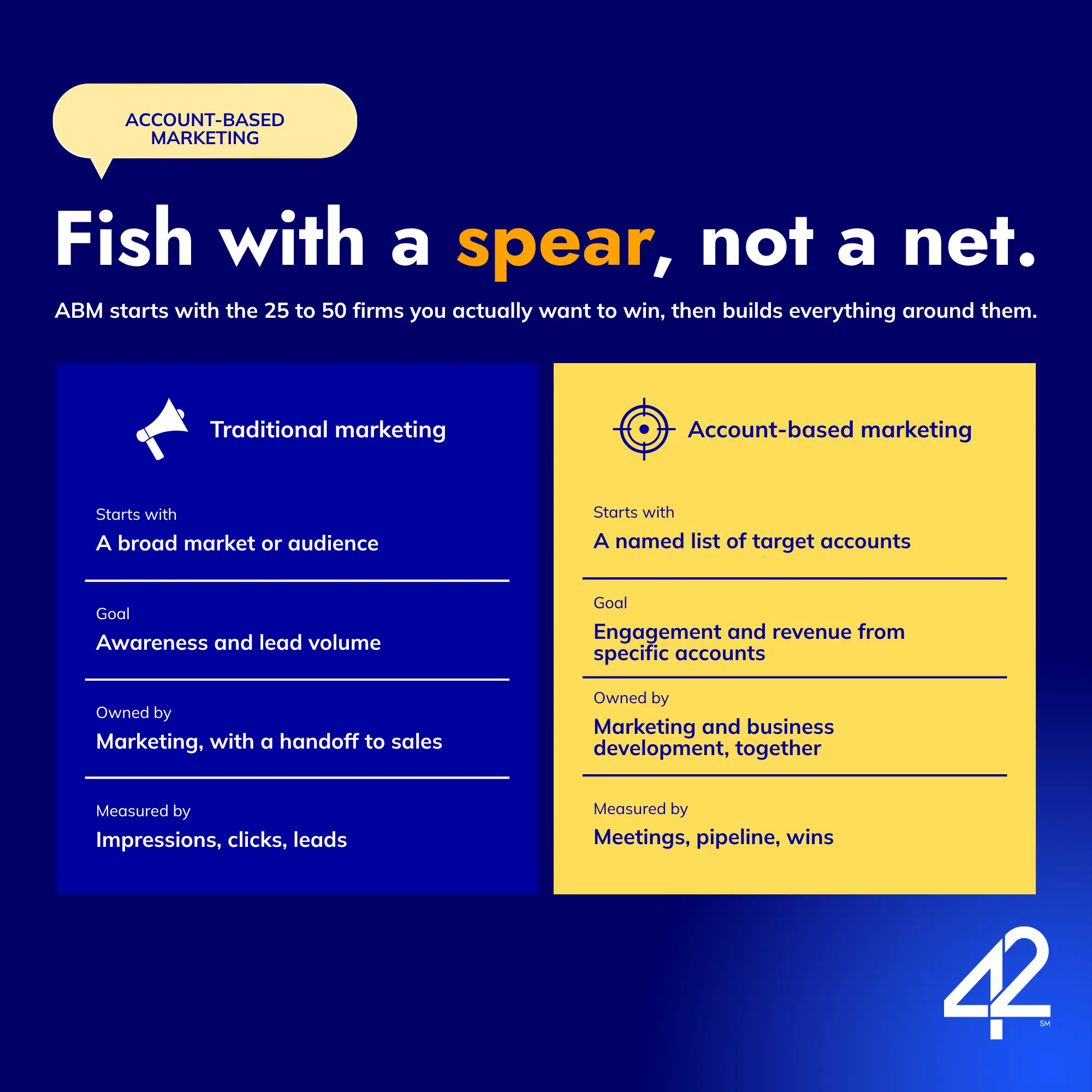
Think of it as fishing with a spear rather than a net. Your target list might be 25 to 50 accounts, not 10,000 contacts. Every message, event invitation, piece of content and sales conversation is shaped for a known audience with known needs.
Why ABM fits professional services
Professional services firms don’t sell products off a shelf; they sell expertise, judgment and trust. Buyers rarely hire an engineering firm, law firm, managed services provider or accounting practice because of a single ad.
There are at least three truths of service-based businesses that make ABM a natural fit:
- The people who do the work also win the work. At most small and mid-sized firms, partners and principals are the business developers. ABM supports those relationships rather than asking leaders to hand over their rolodex to an unfamiliar marketing machine.
- The universe of ideal clients is finite. A firm serving regional developers, mid-market manufacturers or PE portfolio companies can often name its best-fit prospects. ABM puts that knowledge to work.
- Deals are high-value and considered. At most professional services firms, a single new client can be worth years of revenue and multiple projects. Investing focused effort in the right 50 accounts beats spreading thin effort across thousands of names.
The bridge between marketing and sales
ABM sits squarely between marketing and business development, and that hybrid nature is exactly why growing firms find it easier to invest in.
In a traditional model, marketing focuses on the top of the funnel, often generating interest and brand awareness, then handing off leads to sales. In professional services, that handoff can break down because sales either distrusts leads they don’t source, or rank them below their own relationships. Marketing can’t always see what happens after the handoff. Each side ends up questioning the other’s value.
ABM removes the handoff. Marketing and business development agree on the target accounts together, share the same goals and work the same relationships from different angles. Marketing warms the account with relevant insight and visibility; the partner turns that familiarity into a conversation.
This also changes how leadership views the spend. Instead of a budget line justified by impressions or clicks, ABM spend maps to a named list of accounts and the pipeline they produce. Owners and PE sponsors can see exactly where the money goes and what it returns.
That makes ABM a comfortable step for a firm that is growing into marketing. It can start small with a handful of priority accounts, prove results, and expand as the firm adds people, offices and service lines.
Traditional marketing vs. ABM, side by side
The difference comes down to where each approach starts and who owns the outcome.
| Traditional broad-reach marketing | Account-based marketing | |
|---|---|---|
| Starting point | A broad market or audience | A named list of target accounts |
| Goal | Awareness and lead volume | Engagement and revenue from specific accounts |
| Who owns it | Marketing, with a handoff to sales | Marketing and business development together |
| Messaging | One message for many | Tailored to each account’s needs |
| How success is measured | Impressions, clicks, leads | Account engagement, meetings, pipeline, wins |
| Budget feels like | The cost of visibility | An investment in specific relationships |
| Best for | Building recognition across a market | Winning and expanding high-value clients |
ABM builds on brand; it doesn't replace it
ABM is not a substitute for a strong brand. It works best on top of one.
When a partner reaches out to a target account, the prospect will check the firm’s website, LinkedIn presence and reputation. If the positioning is unclear or the brand looks dated, even the best-targeted outreach loses momentum. A clear, credible brand is what makes focused outreach land.
The most effective approach treats them as layers. Brand establishes who the firm is and why it matters. ABM directs that story at the accounts that matter most.
How to get started with ABM
ABM doesn’t require a large team or an enterprise technology stack. Most firms can begin with five steps:
- Define your ideal client. Look at your best current clients by size, industry, geography and the services they buy. That profile becomes your filter.
- Build a focused account list. Start with 25 to 50 organizations that match the profile. Include current clients with room to expand.
- Align marketing and business development. Assign a partner or principal to each account and agree on shared goals before any outreach begins.
- Create relevant content and touchpoints. Develop insight pieces, case studies and event invitations that speak to the issues those accounts face.
- Measure, test, tweak. Track engagement, meetings, proposals and wins by account, then review results together every quarter and adjust where warranted.
How to build off ABM
Once ABM is working, your account list becomes a map of where your firm wins. The next step is to turn 25 to 50 named accounts into two or three clearly defined markets, shaped by your best clients.
- Study your wins. Look at the accounts that engaged, converted and expanded. Note what they share: industry, size, ownership structure, geography, the problem that brought them to you and the services they bought.
- Define two or three niches. Each should be specific enough to name, large enough to sustain growth and backed by proof such as case studies, references and repeat work.
- Build a point of view for each niche. Develop positioning, insight content, speaking topics and association involvement that speak to that market’s specific pressures. Make sure your website speaks to these defined markets. Also make sure you have sales materials ready like Statement of Qualifications (SOQs) pitch decks, and one-page flyers that resonate with each niche.
- Shift from one-to-one to one-to-many. Content and campaigns built for a niche reach every firm in it, not just the names on your list. Prospects you never targeted start finding you.
- Measure at the market level. Add niche-level indicators, such as inbound inquiries and win rates within each niche, alongside your account metrics.
| Tier | Focus | Approach |
|---|---|---|
| One-to-one | Your 10 to 20 highest-value accounts | Fully tailored ABM, led by partners |
| One-to-few | Clusters of similar accounts within a niche | Shared content and events for each cluster |
| One-to-many | Your two or three defined niches | Niche positioning, thought leadership and visibility |
This is how a firm grows into a full marketing program without losing the focus that made ABM work. Every layer is anchored in proven clients, so each new dollar is aimed at a market the firm already knows how to win.
The bottom line
For growing professional services firms, ABM offers something rare: a marketing approach that partners trust, leadership can measure and the business can scale at its own pace. It honors the relationship-driven way these firms have always won work, and it adds the focus and discipline needed to grow beyond referrals.
At Fortify Advisory, we help professional services firms and PE-backed portfolio companies build the brand foundation and targeted growth programs that turn the right accounts into long-term clients. If your firm is ready to grow with more focus, let’s talk.