
Shocking Statistics, Forgotten Pioneers, and Why the World Needs Women (and those who champion them) More Than Ever
In March, we pause to honor the women who shaped history. The female inventors, activists, scientists, artists, and leaders who pushed forward despite a world that often pushed back, are honored for their achievements, and held up as examples for those of us who have come along after them.
But this Women’s History Month, it feels important to not just look back, but to also look squarely at the present. This year, I’m focused on the very real, very measurable ways the deck is still stacked against women in modern times.
And despite this, the extraordinary fact is this: WOMEN ARE RISING ANYWAY.
The below outlines a few modern-day roadblocks to gender equality and shares statistics that are just as much surprising and frustrating as they are inspiring. It ends by telling a story about a group of people, women and the men who championed them, who have accomplished remarkable things under remarkable pressure.
Three Major Roadblocks for Progress to Gender Equality
1. The Modern-Day Childcare and the Career Penalty
I want to start with a statistic that feels abstract until it hits your household budget. As I write this, my husband and I are a few years past childcare costs and are now parents of college students, which also comes with financial anxiety for many parents. But I remember the young parenting years, being a FT mom of three littles and a PT/FT employee. The days were long, the years were short, and the budget was always tight. The federal government’s own definition of “affordable” childcare is care that costs no more than 7% of a family’s annual income.
So if each parent makes $100k annually, you would expect to pay $1,166 per month for your daycare. Even though that benchmark comes from the U.S. Department of Health and Human Services, in the vast majority of American communities, average childcare costs blow past 7% entirely. In my own experience, we averaged ~13+%, and were lucky enough to have had family nearby to help.
We can all agree, the financial burden is enormous. But the career burden falls disproportionately on one gender. When childcare is unavailable, unaffordable, or disrupted, it is overwhelmingly women who step back from their careers to fill the gap.
Consider these numbers from recent research:
- Nearly 90% of the 1.2 to 1.5 million individuals affected each month by inadequate childcare are women, working part-time or missing work entirely. Source: Article by Matthew Nestler, PhD, Senior Economist, published by KPMG Parental Work Disruption Index, published September 30, 2024..
- As of 2025, the return-to-office wave has accelerated the crisis and women with young children who had rejoined the workforce during remote-work years are now exiting again. The steepest drops are among college-educated mothers of very young children. Sources: Article by Matthew Nestler, PhD, Senior Economist, published by KPMG October 1, 2025; Article by Alana Semuels, Senior Correspondent, published by Time Magazine, August 4th, 2025.
The data is clear: even today, when the system breaks down, women bear the cost. This is not a personal choice, it is a structural inequality. And it ripples outward, affecting earnings, retirement savings, career advancement, and lifetime financial security. Women who step back are not less career-ambitious, they are navigating a system that wasn’t originally designed with them in mind.
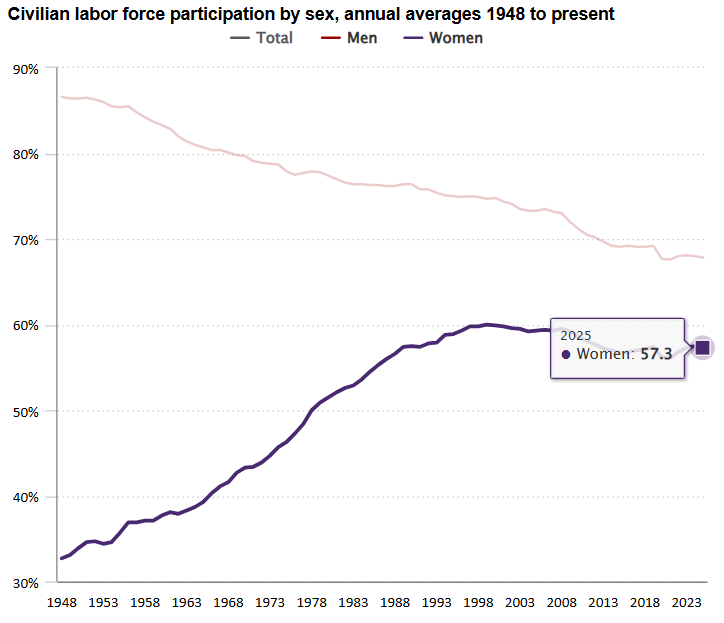
And yet, women are still rising up and contributing significantly in the workforce.
The Bureau of Labor Statistics data shows workforce by gender since 1948, clearly depicting the minority role women have historically played in the workforce, and the significant rise of women in the labor force in the second half of the 20th century, from just 33% in 1948 to 57% in 2025.
2. The Inequality of Safety and Security
When we talk about the challenges of modern times that are uniquely faced by women, we’d be remiss to not talk about security and safety. The threat of violence shapes the daily lives of women in ways their male counterparts rarely experience.
While overall violent crime rates in the U.S. have fluctuated across both genders, the nature and source of violence women experience is fundamentally different. Where men are more likely to be victimized by strangers, women are overwhelmingly targeted by people they know, including partners, family members, and acquaintances. The home, which should be the safest place, is statistically the most dangerous place for women.
- In 2024, 19% of female violent crime victims identified an intimate partner as their offender, compared to just 5% of male victims. Source: Council on Criminal Justice, Women’s Justice: By the Numbers, 2024.
- 60% of all female homicides globally are committed by intimate partners or other family members. For male homicide victims, that figure is just 11%. Source: UN Women, Facts and Figures: Ending Violence Against Women, 2024.
- Women are significantly more likely than men to be victims of rape and sexual assault, stalking, and intimate partner violence. Of course, these crimes are also among the most chronically underreported. Source: US Department of Justice, Bureau of Justice Statistics, Criminal Victimization, 2023.
These are not statistics from another era or another country. This is the lived reality of women in the last three years in American homes, on American streets. And yet women continue to lead, to build, to innovate, and to show up every day. The courage that requires is rarely acknowledged.
3. The Inequality of Representation
It is not just in what happens to women today that stacks the deck against us, it is also what gets erased about women from yesterday. For generations, women have often been forgotten, or worse, written out of history. There is a well-known and long tradition of crediting men for discoveries that women helped make, leaving future generations of girls without the role models they deserve.
“For most of history, Anonymous was a woman.”
– Virginia Woolf
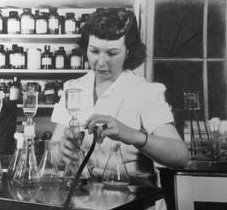
One modern-day story that illustrates this is that of Elizabeth Bugie.
In 1943, at Rutgers University, a research team that included Elizabeth Bugie was on the verge of one of the most consequential medical discoveries of the 20th century: streptomycin, the first antibiotic effective against tuberculosis (TB). At that time, TB was the second-leading cause of death in the United States. The discovery paper, published in January 1944, bore three names: Albert Schatz, Elizabeth Bugie, and Selman A. Waksman. Yet when the patent was filed, Bugie’s name was left off.
Elizabeth Bugie was a master’s student researcher, and according to Selman Waksman’s own written account in 1950, Bugie’s contributions to the discovery were at least as significant as those of her colleague, Schatz. Source: American Chemical Society, record dedicated May 24th, 2005.
When Elizabeth Bugie passed away in 2001, an article was published in the Pittsburgh Post Gazette where Bugie’s daughters, Professor Eileen Gregory and Patricia Camp, talk about their mother’s involvement in the discovery of streptomycin: their mother was privately approached by colleagues and told that because she would one day marry and have children, it “wasn’t important” for her name to appear on the patent. Bugie later signed an affidavit stating she had not contributed to the discovery, a document historians have since viewed with deep skepticism given the weight of contrary evidence.
In 1952, Selman Waksman was awarded the Nobel Prize in Physiology or Medicine for the discovery of streptomycin. Elizabeth Bugie was not mentioned in the Nobel citation and when royalties were eventually distributed after a legal dispute, Waksman received 10%, Schatz received 3%, and Bugie received just 0.2%.
Bugie’s daughter said of her mother, “she did research not for notoriety but for love of science.” But Bugie herself, near the end of her life, acknowledged that if the women’s liberation movement had existed during her career, she would have fought for the credit she deserved. Sources: Article by Jennifer Goff, PhD, published by American Society for Microbiology, March 15, 2024, Article by Lidiya Angelova, published by Scientist Foundation, August 8, 2018.
Elizabeth Bugie is not an isolated case. She is one of countless women whose contributions to science, art, literature, engineering, and medicine were minimized, misattributed, or outright erased. When history fails to record women’s achievements, it fails every girl who comes after them, and every girl who needs to see herself reflected in the stories of those who came before.
The Rise: What Women Are Accomplishing Despite It All
Now for the part that should make every woman reading this stand a little taller, and make EVERYONE reading this want to be part of what comes next. Because here is the truth: women are building, leading, inventing, and succeeding at a pace that no obstacle has been able to stop.
- As of 2024, there are approximately 13.5 million women-owned businesses in the United States — up from just 402,000 in 1972.
- Women entrepreneurs grew by 41% year-over-year in 2024, outpacing their male counterparts by 25%.
- In private companies valued over $1 billion, women’s representation as CEOs saw a 118% increase from 2023 to 2024.
Source: Women Business Collaborative, 2024 Women CEOs in America Report, published September 24th, 2024.
We all know these gains did not come easily or freely. They came in spite of childcare crises, in spite of safety and security threats, and in spite of erasure. That is not just impressive, it is extraordinary.
This year, in celebration of Women’s History Month I honor every woman who balances parenting and a career, and those who contribute to her home and community even when it doesn’t feel safe or secure.
And as Women’s History Month is honored and celebrated, consider sharing Elizabeth Bugie’s story, or share about another accomplished woman whose name was left off the patent or wiped from the history pages.
May the gains continue to come because women and those who champion them, refuse to stop.
P.S. They told Elizabeth Bugie her name didn’t need to be on the patent — that someday she’d get married and have a family, and that would be enough. What they didn’t anticipate is that she would do both, and that the family she raised would carry her legacy forward. Both of her daughters followed her into science: Eileen Gregory went on to become a microbiologist, and Patricia Camp earned degrees in chemistry and microbiology before working as a chemist. Elizabeth Bugie may have been written out of the patent, but she was never written out of the lives she inspired, starting with her own daughters. That, it turns out, is its own kind of legacy.